Formed In Faith
Sharing the Word through Faith Formation, Archdiocese of Louisville

University of Dayton’s Virtual Learning Community

The Archdiocese of Louisville is a partner diocese with the VLCFF.
Haven’t taken a course in at least 5 years?
Email John, JLeComte1@udayton.edu, about a take one, get one special!
Click here to see Cycle 2 course list. Starts March 1 !


Catechesis of the Good Shepherd Training at St. Meinrad
 If you are ready to revitalize formation and discipleship of young people, you might consider learning more about an approach that incorporates wonder, discovery, and encounter. Children and young people discover who God is and begin to deepen their gift of faith by nurturing their capacity for encounter, engaging their imagination and developing a lifelong relationship with the divine. Saint Meinrad is offering a unique opportunity to equip leaders to implement Catechesis of the Good Shepherd as an innovative approach for formation and discipleship.
When: June 10-14, 2020; July 16-19, 2020; and January 7-10, 2021 (90 contact hours for national certification)
Where: Saint Meinrad campus, 200 Hill Drive, St. Meinrad, IN 47577
For more information or to talk about the availability of schol arships contact Agnes Kovacs at St. Meinrad
Agnes M. Kovacs
Director, Continuing Formation
Associate Director, Graduate Theology Programs
Saint Meinrad Seminary and School of Theology
200 Hill Drive
St. Meinrad, IN 47577
Ph: 812-357-6087


Five times to anoint a catechumen during the RCIA process
 A while ago, I tried a new recipe that called for coconut oil. It was the first I’d heard of that kind of oil. Over my many years in the kitchen, I’ve expanded my repertoire beyond to Wesson Oil my mother used for cooking and the Crisco my grandmother used for baking. California olive oils are a distinct as its wines. Peanut and grapeseed oils are great for deep frying because of their high smoke points. Sesame oil gives Asian stir fry a particular character.
What types of oils does the church use?
The church also has specialty oils for particular uses. Chrism is both the holiest and most versatile oil, used in multiple sacramental and near-sacramental rituals. We use chrism to anoint in the way Christ is anointed.
The oil of the sick has an obvious single use, but — unlike when I was a child — it can be used multiple times. It used to be reserved for those close to death (“extreme unction”), but it is now used for anyone who suffers from serious, though not necessarily terminal, illness.
The oil of catechumens is perhaps the least familiar of the church’s oils. It might be the “coconut oil” that many of us have not yet heard of.
Click here to continue ready this article from Team RCIA.

VLCFF- 20 years
The Archdiocese of Louisville is a partner with VLCFF and we wish to congratulate VLCFF for 20 years of ministry.
Click here to see a full listing of classes available from VLCFF.
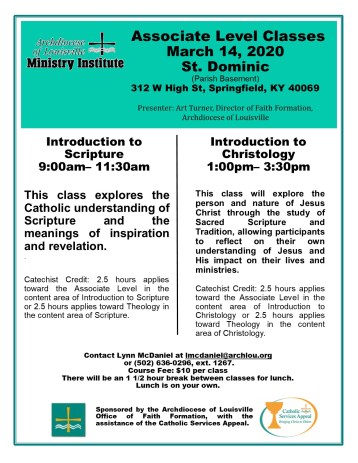
Spring 2020 Catalogue
The Spring Catalogue is now available! Be sure to share the catalogue with your fellow catechists; teachers, youth ministers, RCIA team members, etc.

Happy Thanksgiving!

Happy Thanksgiving from the Office of Faith Formation!
Please note our office will be closed Nov. 28 and 29 for the holiday.



 Formed In Faith