written by Timothy P. O’Malley
https://churchlife.nd.edu/
In less than three weeks, I’ll be back in the classroom teaching an intensive course introducing over forty students to a fundamental theology for catechesis. Most of my students will be parish ministers, high school teachers, or those involved in campus ministry at a secondary or collegiate level. Each day of the class on our blog, I will offer a series of reflections drawn from our syllabus to invite readers to follow along virtually.
Yet, before launching into this virtual syllabus, I wanted to offer a defense of the course’s title: Introduction to Catechetical Theology. Often enough in the academy, catechesis is preceded by the term “mere.” While the theologian advances knowledge and is engaged in critical inquiry, the catechist is “merely” teaching the particulars of Christian faith.
Such an assumption fails to grasp that the catechist is performing an act of theological interpretation in every moment of teaching. As Augustine notes in his De doctrina christiana (On Teaching Christianity), the first act of the teacher is not presentation but interpretation. A catechist without a theological education is for this reason a danger in the classroom, who will either rigidly present a Tradition to the student or will deform Catholic teaching in the process of teaching.
The last fifty years of catechesis in the United States has been dominated by these twin problems. Some methods in religious education have placed undue emphasis upon either the subjective or the communal appropriation of the Tradition. Relying upon methods of critical correlation in which the Tradition is modified through “experience,” what is passed on is often not Catholic. The Resurrection, for example, is not another example of how life comes out of death. Rather, it is the moment that Jesus, the God-person, is resurrected from the dead. In which our understanding of what it means to die as a human being is forever changed. To reduce the particular claim of the Resurrection to a general religious truth is frequently the result of these methods of critical correlation.
Article by Jose Gonzalez on http://www.ncea.org
The Sharing of the Gospel with non- Catholics is the essence of our Christian mission of evangelization. but how do we do this as teachers in Catholic schools, without sidelining our Catholic students, while preserving our schools’ Cahtolic identity? Can it be done?
The Loyola Institute for Ministry Extension Program (LIMEX), offered by the Archdiocese of Louisville and Loyola University New Orleans, is accepting adult students for a new learning cohort to begin coursework in the fall.
LIMEX offers master’s degrees and graduate certificates in theology and ministry, and continuing education credentials.
“It’s really designed for anyone who wants to learn about their faith on a deeper level. And it gives them the background to do ministry,” said Art Turner, director of the Archdiocese of Louisville’s Office of Faith Formation. “It’s also meant to be a help for people who would like to work for the church and someone who can’t do a traditional program.”
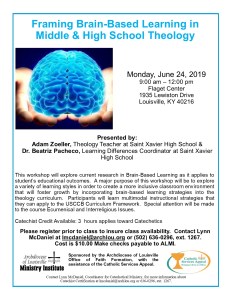
Have you thought about attending the Parish Catechetical Leadership Insititue, July 14-18, 2019? The registraiton deadline is June 15th. Financial assistance is available for PCLs in the Archdiocese of Louisville through our office.
Our summer catalogue is almost ready, but until then here are two classes you may want to consider…
Images of God
Date: Monday, April 15, 2019
Time: 3:15 p.m.- 5:45 p.m.
Location: St. Paul
Presenter: Art Turner, Director of the Office of Faith Formation, Archdiocese of Louisville
Cost: $10.00 (check payable to ALMI)
Registration: Register prior to class to insure class availability. Contact Lynn McDaniel at lmcdaniel@archlou.org or (502) 636-0296, ext.1267.
Catechist Credit: 2.5 hours applies toward the Associate Level in the area of Images of God or Theology in the area of Spirituality
This class is an exploration into both the personal and communal images of God and how they impact our sense of community and ministry.
…we have compiled the following summary of RCIA facts. You might call it a bishop’s “cheat sheet” of sorts. Some points may already be familiar, and others might come as a surprise. Some might affirm your current diocesan practice, while others may invite you to take another look at the rite. In any case, we hope this list can be helpful to you, your seminarians and other leaders in formation, and to those you have delegated to steward and oversee the initiation process in your parishes, schools, and communities.
It is not too late to register to attend the 2019 Louisville Catholic Men’s Conference. You can register online at https://www.archlou.org/mensconference/.
Catechist Credit is available. You must be a registered participant. Then after attending the conference fill out an evaluation form and send it to the Office of Faith Formation.
Thursday, April 4, 4 p.m. EDT
Engaging Parents
as Learners and Teachers
Sue Muldoon, MA, will explore options for structuring family religious education that help parents to partner with their child’s catechist and empower children to grow in faith.
Thursday, April 11, 4 p.m. EDT
The Outpouring of
the Holy Spirit in Our Lives
Donna Eschenauer, PhD, explores the Sacrament of Confirmation and the profound meaning of the ongoing reality of the “outpouring of the Holy Spirit” in our everyday lives. Practical application and questions for reflection will be offered to participants.
https://www.sadlier.com/religion/resources/lifelong-learning-webinars
Tune in Thursday, March 28 at 3:30pm to 840 WHAS Radio when Terry Meiners will host Archbishop Kurtz as they talk about the upcoming Men’s Conference.
For more information or to register for the conference go to
https://www.archlou.org/mensconference/.
https://whas.iheart.com/featured/terry-meiners/