Formed In Faith
Sharing the Word through Faith Formation, Archdiocese of Louisville

Webinar – Lent in the Year of Mercy
Greetings. May this Lent bring us all a true conversion, renewal, and hope!
The idea- and resource-filled, online newsletter called eCatechist has posted a timely, free webinar. (http://www.ecatechist.com)
The webinar is ‘Lent in the Year of Mercy’ — presented by Rev. Frank DeSiano, CSP, of the Paulist Evangelization Ministries. It runs for 51 minutes.

Rev. DeSiano
Thanks to Daniel Pierson, the founder of eCatechist, the presentation is easy to access. Simply click:
http://www.ecatechist.com/2016/02/lent-in-the-year-of-mercy-with-fr-frank-desiano-csp.html
While you are on the eCatechist page, be sure to subscribe. Very practical indeed!

Butch Ekstrom 10 February 2016
### ### ###
Pope Francis to share monthly prayer intentions on video
2016-01-04 Vatican Radio, Seàn-Patrick Lovett’
This month the Apostleship of Prayer, set up in 1844 by a group of Jesuit seminarians in France, is also launching a new international website and app aimed at facilitating collaboration and sharing of resources between teams from the Pope’s Worldwide Prayer Network.
The production of a video with Pope Francis sharing his monthly prayer intentions has been been managed in collaboration with the Vatican Television Centre.
The video, in 10 languages, will be available on YouTube as well as on social media sites including Facebook, Twitter and Instagram, encouraging people all over the world to pray with the Pope each month.
The first video will feature the Pope’s prayer intention for January: “That sincere dialogue among men and women of different faiths may produce the fruits of peace and justice”.
To view the Apostleship of Prayer website click here.
Pope, Russian Orthodox patriarch to meet in Cuba, Vatican announces
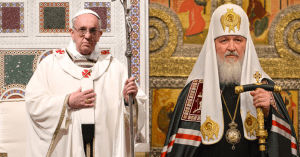
After almost three decades of tense Catholic-Russian Orthodox relations, Pope Francis will meet Patriarch Kirill of Moscow Feb. 12 in Cuba on the pope’s way to Mexico.
It will be the first-ever meeting of a pope and Moscow patriarch, Jesuit Father Federico Lombardi, Vatican spokesman, told reporters Feb. 5.
To read the entire article click here.
By Cindy Wooden
Catholic News Service
A Holy Year of Mercy Faith Fact

Pope Francis announced an Extraordinary Jubilee, a Holy Year of Mercy, to highlight the importance of being merciful to one another as God is to us. What does this mean for parish and school leaders, catechists, and parents? Download an informative Faith Fact with information about the Holy Year of Mercy and helpful suggestions for teaching about mercy and celebrating the Holy Year of Mercy in the parish, school, home, and community.
Fill out the form to download A Holy Year of Mercy Faith Fact now.

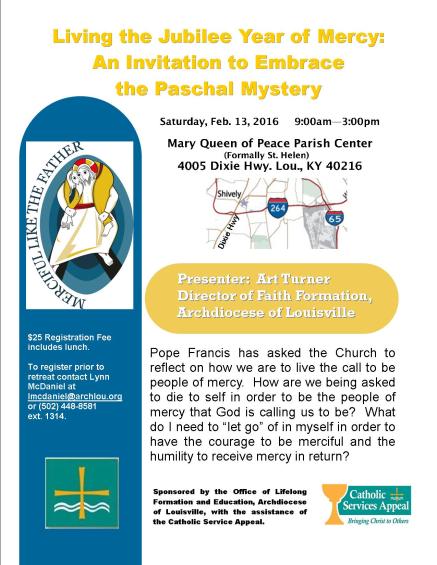
Living the Jubilee Year of Mercy
Please note that an earlier flyer has been circulated that has the incorrect location.
This retreat will be at Mary Queen of Peace (formally St. Helen.)
6 credit hours for Catechist Certification in the area of Spiritual Formation will be applied
Office Closed/ Justice Workshop Cancelled

Due to the weather our office is closed today.
Please note the Justice Workshop
scheduled for Sat. Jan. 23, 2016 has been cancelled.

Justice Workshop, 1/23/16- CANCELLED
 CANCELLATION!!!
The Justice Workshop- Solidarity with the Poor on Saturday, Jan. 23, 2016 has been cancelled.
At this time we do not plan to reschedule the event.

Mercy? – Yep, There’s an App for That!
Bring the Jubilee Year of Mercy to your parish and school communities in a new way.
From Our Sunday Visitor Publishing comes the free 365 Days to Mercy app

Download this clever cellphone tool from the iTunes or Google Play app stores. Designed to accompany adults and youth on their spiritual journeys through the Jubilee Year of Mercy, once installed the app provides tweets by Pope Francis, daily devotionals and meditation points on mercy, prayers, bible stories, and news (up to November 20, 2016 — giving one a full year, 365 Days of Mercy).
Web info from OSV: https://osv.com/yom
Butch Ekstrom January 20, 2016
### ### ###
Catholic Men’s Conference Registration
Registration for the Catholic Men’s Conference 2016 is now open!
Follow the link below to register online:
Catholic Men’s Conference 2016, Louisville
“Made for More”
March 5, 2016
8:00 am – 1:00 pm
Saint Michael Catholic Church
3705 Stone Lakes Dr.
Louisville, KY 40299
Fee: Adults: $30 • Students: $15
Space limited to the first 800 to register.
Scholarships available by request.
Keynote presentation with Curtis Martin
We have been “made for more” than just the intoxication of this world. We have been made for greatness – and we will only reach such heights when we first come into a relationship with Jesus Christ.
Curtis Martin is the Founder and CEO of the Fellowship of Catholic University Students (FOCUS), one of the fastest growing programs in the Catholic Church. Curtis holds a Master’s degree in Theology and is the author of the best-selling book Made for More. In 2004, Curtis and his wife Michaelann were awarded the Benemerenti Medal by Saint John Paul II for their outstanding service to the Church. In 2011, Pope Benedict XVI appointed Curtis as a Consulter to the Pontifical Council of the New Evangelization. Curtis and his wife, Michaelann, live in Westminster, CO. They have been blessed with nine children.
For more information on Curtis Martin please visit: http://www.focus.org/about/curtis-martin.html
The Day’s Agenda
8:15 am Welcome
8:30 am “Made for More” Part 1
Curtis Martin, Founder & CEO – FOCUS
9:15 am “Wright’s Law: A Unique Teacher
Imparts Real Life Lessons”
Jeff Wright, Science Teacher – Male HS
9:45 am Workshops / Reconciliation /
Refreshments
10:45 am “Made for More” Part 2
Curtis Martin, Founder & CEO – FOCUS
11:15 am Final Comments
Most Rev. Joseph E. Kurtz, D.D.
12:00 pm Closing Liturgy
Most Rev. Joseph E. Kurtz, D.D.
1:00 pm Conclusion
Optional pizza lunch, fellowship, & follow-up
Weather Cancellations??
Please note, that there is the possibility of the coming weather cancelling the workshop for this Saturday.
If this should occur, we will post the cancellation to this page.
 .
.



Archdiocese of Louisville
USCCB

 Formed In Faith