Formed In Faith
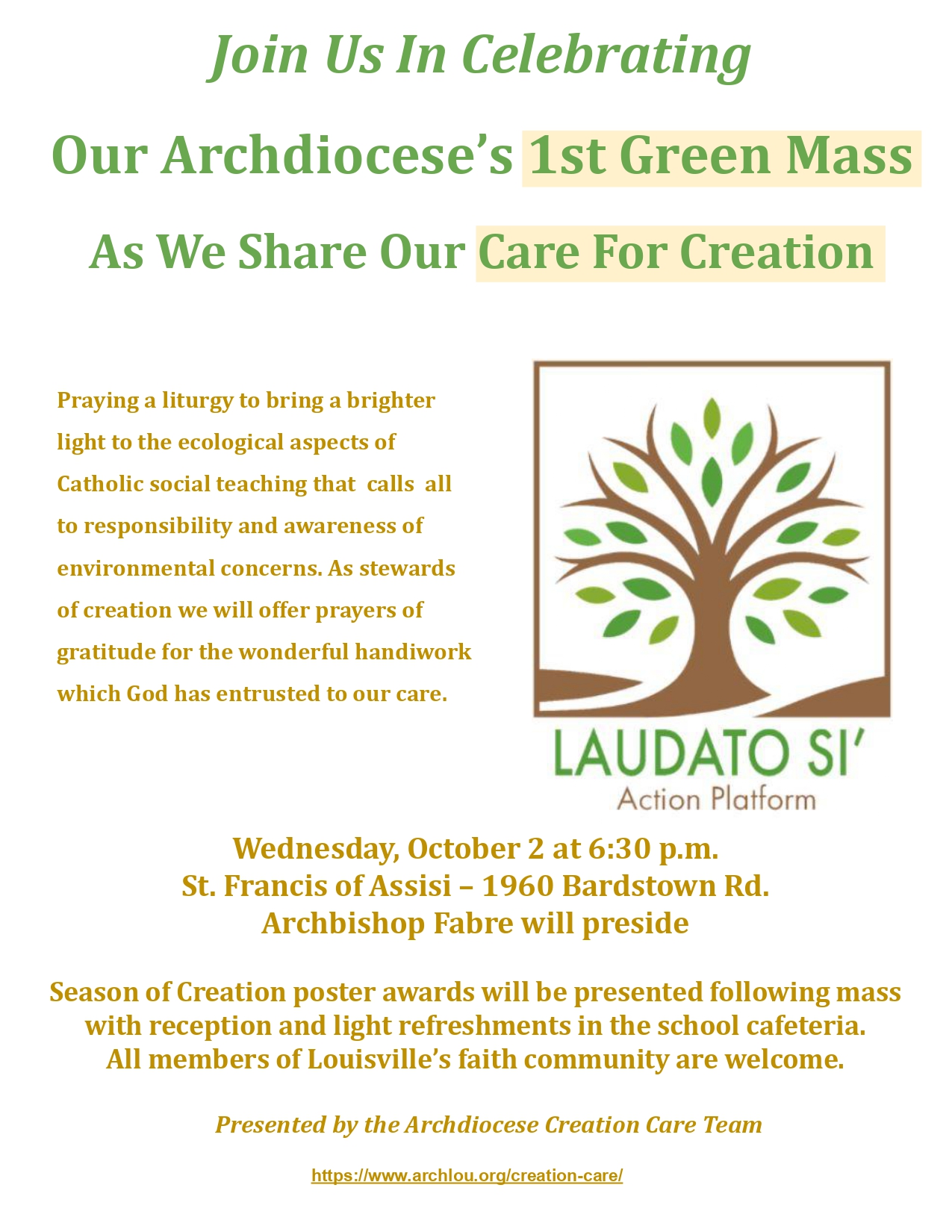
Sharing the Word through Faith Formation, Archdiocese of Louisville

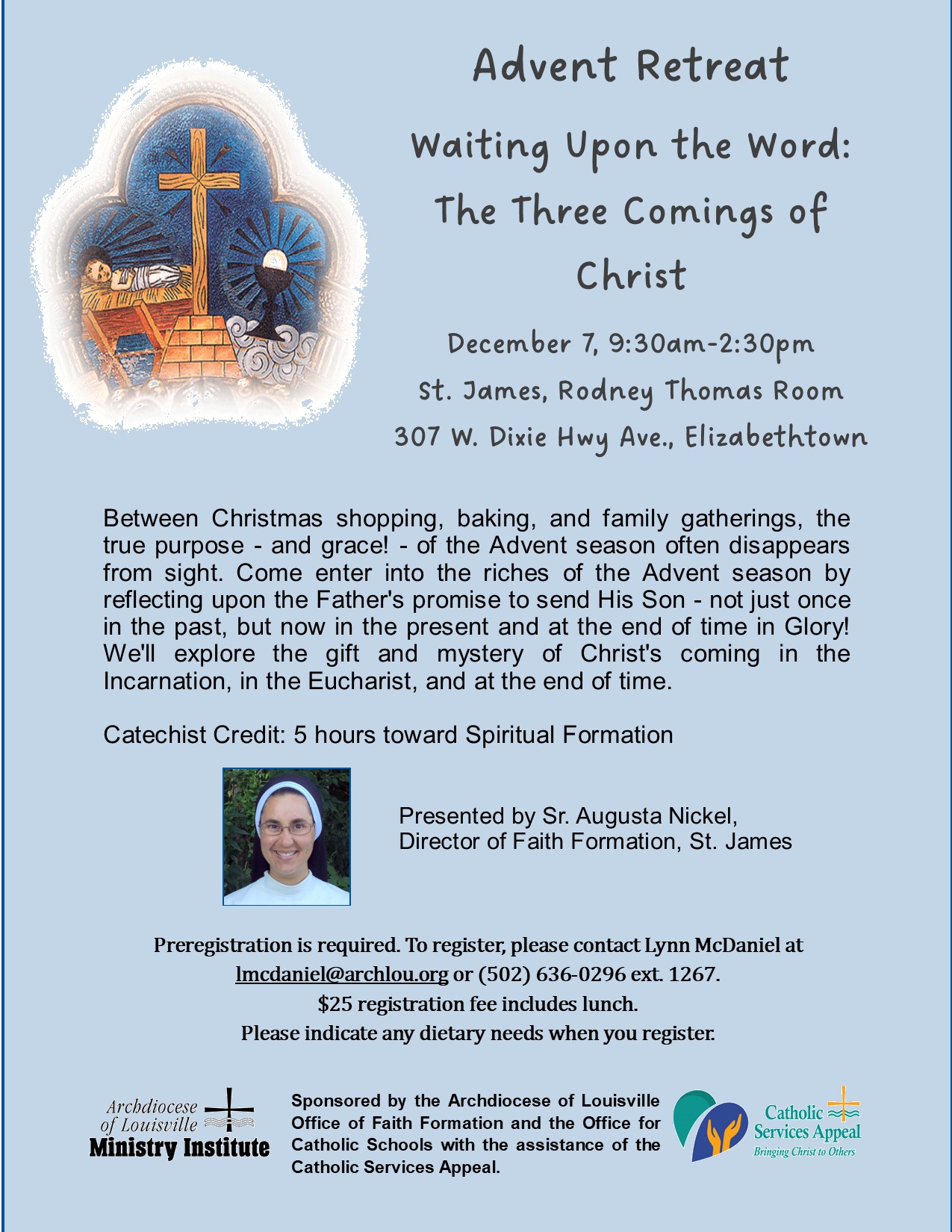
National Statutes for the Christian Initiation of Adults: Effective 12/1/24
The effective date of the National Statutes for the Christian Initiation of Adults in the
dioceses of the United States of America will be December 1, 2024, the First Sunday of Advent.
If you have questions about these statutes or initiation of adults (RCIA/OCIA) contact Laura Zoeller in the Faith Formation office.


Catechists from around the archdiocese, including those who lead Faith Clubs, honored
The Archdiocese of Louisville’s Office of Faith Formation honored 138 catechists during the annual Faith Formation Celebration held Sept. 26 at St. Margaret Mary Church.
Archbishop Shelton J. Fabre thanked the catechists for directing the archdiocese’s efforts in faith formation and formal catechesis. He also noted, “Every disciple of Jesus Christ is tasked with evangelizing and forming others in the faith by sharing their faith and their relationship with Jesus Christ.”
Three catechists — Rachel Jakubiak, Tara Mattingly and Debbie Shearn — were honored with the Roncalli Award, the highest award given. The archdiocese also recognized dozens of individuals who have completed certifications as associate, advanced or master-level catechists.
And for the first time, the office honored past and present leaders of Faith Clubs as catechists. Faith Clubs provide faith formation for adults with developmental or learning disabilities.
“It’s important that we acknowledge them for answering this call,” said Laura Zoeller, consultant for adult formation and initiation. “Our Faith Clubs aren’t just social clubs. They have catechesis in each session.
Click here to continue reading this article.
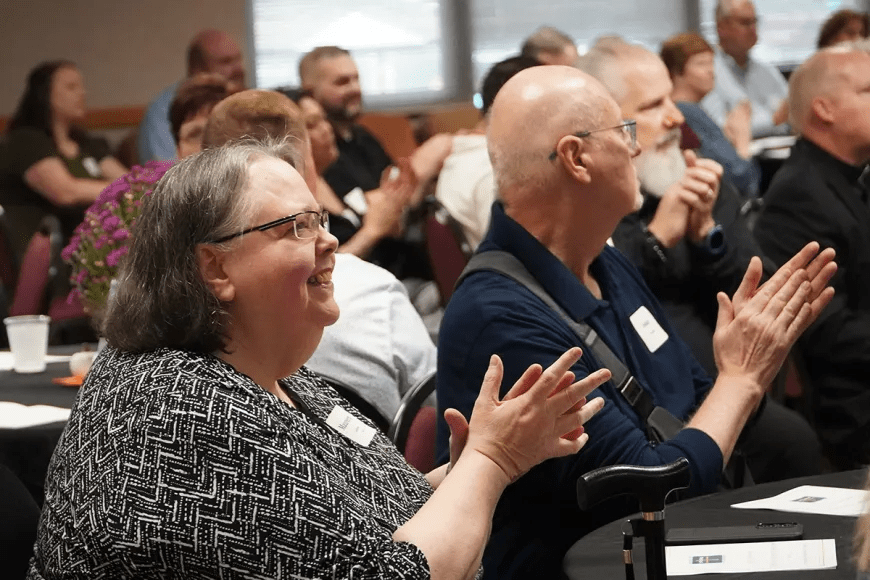
The Archdiocese of Louisville’s Office of Faith Formation honored past and present Faith Club leaders as catechists Sept. 26 during the annual Faith Formation Celebration at St. Margaret Mary Church. Maureen Grisanti Larison, center, was among those recognized for her contribution to the Faith Clubs. (Record Photo by Olivia Castlen)
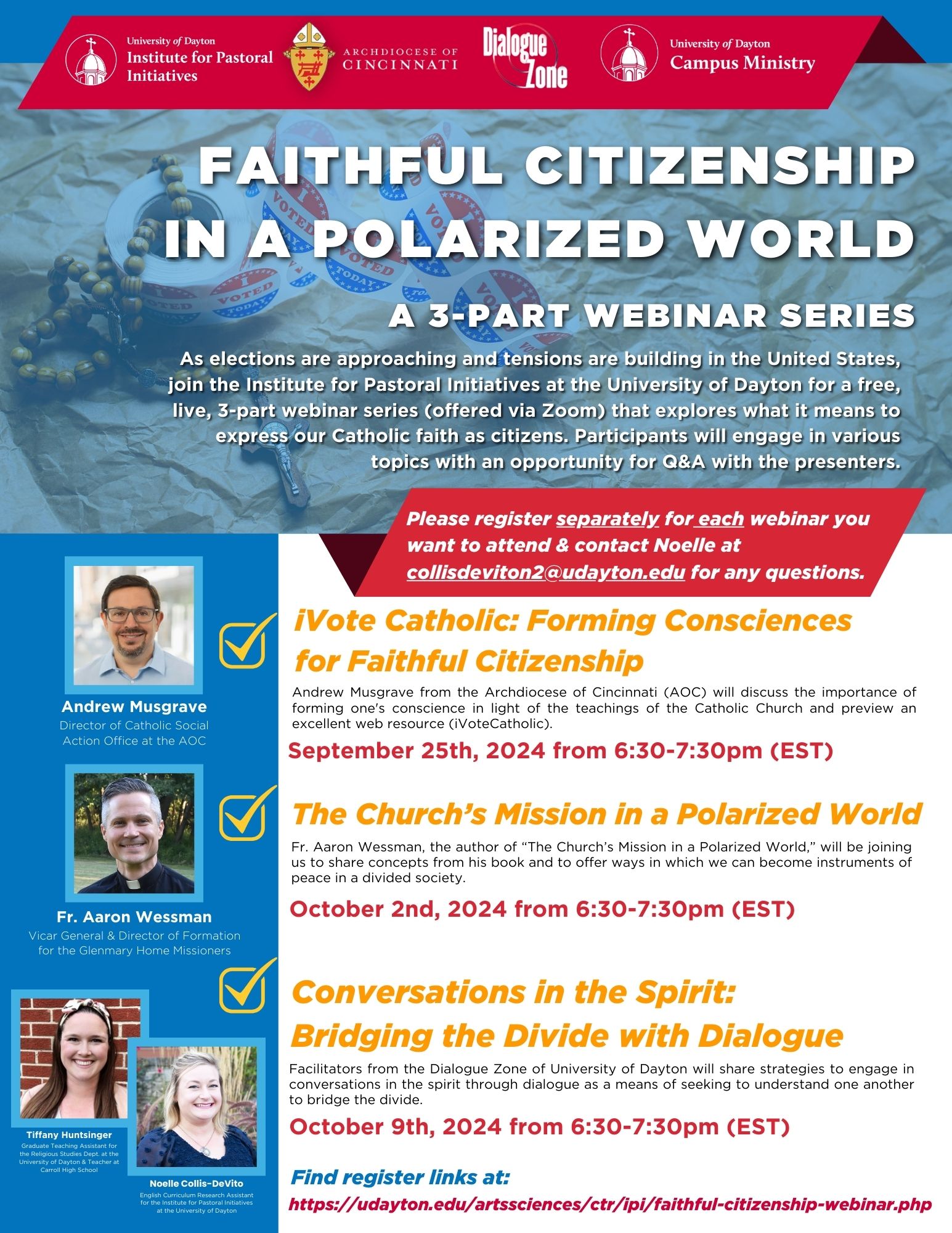
McGrath Institute for Church Life Webinar
Conversations that Matter: Reimagining Politics in the Light of the Eucharist
Online Webinar
Tuesday, October 22, 2024 | 12:30 pm EDT
American political life is characterized by hyper-partisanship and polarization. Each election cycle seems to sharpen divisions and deepen political idolatry, while leaving most of us exasperated and exhausted. Yet, the Catholic Church encourages us to participate in politics. Pope Francis expresses the Church’s conviction that politics is “a lofty vocation and one of the highest forms of charity, inasmuch as it seeks the common good” (EV, 205).
This series explores the Church’s call to participate in political life and the complexities, challenges, and possibilities therein: What is politics? How do Catholics balance the call to participation without making an idol of politics? Is our call to participate exhausted by our duty to vote? What is the mission of Catholics in the public square? What constitutes the public square? How can the Eucharist transform our understanding of politics? Can we envision a world where charity, not political ideology, guides all our actions and decisions?
Featured Panelists
F. DeKarlos Blackmon, Ph.D. is the Vice Chancellor for Pastoral Services for the Archdiocese of Louisville. He has completed graduate studies in pastoral ministry, business, and education and holds a doctorate of education. DeKarlos has previously served as the Supreme Knight, chief executive officer and chairman of the board of the Knights of Peter Claver (2010-2016), and deputy president and president of the International Alliance of Catholic Knights (2013-2015, 2015-2017). He has also served as a consultant to the U.S. Conference of Catholic Bishops Subcommittee on African American Affairs during the drafting of the 2018 Pastoral Letter Against Racism, Open Wide Our Hearts: The Enduring Call to Love. Blackmon is married to Dame Kanobia A. Russell-Blackmon, the chief communications officer for the Archdiocese of Louisville.

Robert Dunn, J.D. is the Director of Public Policy for the statewide Diocese of Manchester (NH). Bob’s legal career has included service as an Assistant Attorney General in the NH Department of Justice and as the Assistant Commissioner of the NH Department of Safety. Before taking on his current position with the Diocese, he was the director of government relations for one of New Hampshire’s largest law firms. Currently, he is a member of the Board of Trustees of Saint Anselm College, the Board of Directors of New Hampshire Humanities, and the State of New Hampshire Commission on Holocaust and Genocide Education. Bob is a graduate of Georgetown University Law Center and the College of the Holy Cross. He is also a member of the inaugural cohort of the McGrath Institute for Church Life Mathis Liturgical Leadership program. He recently published The Eucharist and the Transformation of Politics in Church Life Journal.

Holly Taylor Coolman, Ph.D. is Assistant Professor of Theology at Providence College. She earned her Ph.D. at Duke University, and her areas of interest include social dynamics, polarization, and the law. Recent publications include “Polarization and its Discontents” in Polarization in the US Catholic Church: Naming the Wounds, Beginning to Heal (2016), and “‘Danger Invites Rescue’: An Argument for Legal Protection of Unborn Life,” in the Journal of Moral Theology (Vol. 12, Issue 1, 2023).



CERTIFICATE IN THE PRACTICE OF CATECHESIS
Get a Certificate in the Practice of Catechesis! The next online certificate program begins in January. Learn more – and save your spot! https://www.ncclcatholic.org/certificate
The Practice of Catechesis with All Ages Certificate Program is designed to provide a holistic educational experience for all leaders in catechetical ministry, integrating personal spiritual growth, leadership formation, and the latest thinking, approaches, and skills for catechesis with all ages and generations. The emphasis of the Certificate Program is on practice – equipping leaders for the requirements and challenges of their role as the leader of the parish’s catechetical ministry with families and all ages.



 Formed In Faith