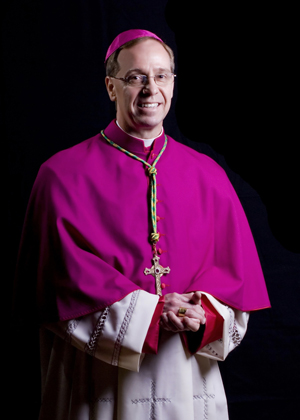
Pope Francis has named Bishop Charles C. Thompson of Evansville, Ind., to head the Archdiocese of Indianapolis. Bishop Thompson is pictured in an undated photo. (CNS photo/the Message)
Pope Francis has named Bishop Charles C. Thompson of Evansville, Ind., to head the Archdiocese of Indianapolis. Bishop Thompson is pictured in an undated photo. (CNS photo/the Message)
Archbishop-designate Thompson, 56, a native of Louisville, was vicar general of the Louisville Archdiocese from 2008 until he was named bishop of Evansville. He also served as pastor of Holy Trinity Church beginning in 2002 and taught canon law at St. Meinrad Seminary and School of Theology in Southern Indiana.

In Portugal the 13th of June is a great feast, the feast of St. Anthony of Lisbon, known to most Catholics as St. Anthony of Padua. This Franciscan miracle-worker was born in Lisbon and had entered religious life as a Canon Regular of the Holy Cross, residing first in Lisbon and then Coimbra, before leaving the Portuguese order for the new Order of Friars Minor and a hope of martyrdom. It was, and is, THE children’s feast in Portugal, so the parents of Lucia naturally thought that the festivities at the parish church in Fátima would distract her from the appointment at the Cova. However, undismayed by this tactic Lucia and the Marto children proceeded to the apparition site to keep their noon day rendezvous.
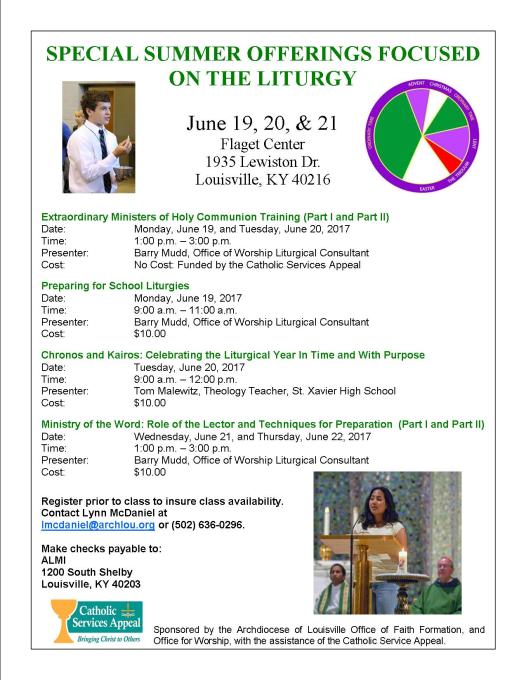
Catechist Credit is available.
By Simcha Fisher
Simcha Fisher is the author of The Sinner’s Guide to Natural Family Planning and blogs daily at simchafisher.com
“We usually keep this one locked,” the friendly usher explained as he opened the little door. He smiled brightly and tried to usher us in.
It was Sunday Mass and we were, of course, outside the church. In our family, we don’t expect kids to make it through the entire service until they are at least four; and this particular kid is only two, and such a two year old. She wants to give glory to God by ripping up the paving stones out of the little Mary garden and throwing them over the railing, shouting, “BYE, ROCKS!”To change things up last week, she circled around the other side of the church, and, before I could reach her in my Sunday heels, she started pounding on a little side door and rattling the handle. Thus the friendly man unlocking that mostly-unused door and trying to let us in.
The reason I’m telling you this is because the Francis Papacy has sparked many a fracas over who does and does not get to come in to the church, and how.
I find it hard to take it seriously when folks argue that we have to be very, very cautious and strict about whom we let in. If that were the case, 100% of us would be out of luck, disqualified, cast out to wail and gnash our teeth. It behooves us – those of us who consider ourselves solid Catholics with uncomplicated marital histories with a firm grasp of basic doctrine – to remember that we don’t have any right to be here. We didn’t earn it, and we certainly don’t deserve it. And yet here we are, every week or maybe even every day, eating God and fumbling our way toward eternal life. Non nobis, domine, non nobis. I know.
by Melanie Miller

A week after Christmas, after months of preparation, my two youngest children received their First Holy Communion. I had always assumed that while welcome at mass, this particular avenue of grace would always be closed to them because of their disabilities. Jude was born with severe cerebral palsy due to an injury at birth and his older sister, Josie, has profound autism.
Click here to continue reading the article.
Resources for Catechesis for Persons with Disabilities
The National Catholic Partnership on Disability has extensive resources for catechesis (and inclusion in parish life):
https://www.ncpd.org/ministries-programs/catechesis
The Rose Fitzgerald Kennedy Curriculum is a time-tested, traditional resource for sacramental preparation:
https://store.rclbenziger.com/product/rose-fitzgerald-kennedy-program-english-version-special-needs
There are several options in the Inclusive Catechesis Resources from University of Dayton’s Institute for Pastoral Initiatives:
https://www.udayton.edu/artssciences/ctr/ipi/inclusive_catechesis_resources/index.php
Loyola Press publishes various adaptive and inclusive catechetical materials:
https://www.loyolapress.com/products/special-needs
For more information about catechesis of adults or children with disabilities contact Maureen Larison, Consultant for Adult Formation and Initiation, at mlarison@archlou.org or 502-636-0296 Ext. 1269.

On May 13, 1917, Lucia dos Santos, Francisco, and Jacinta Marto were, respectively, ten, nine, and seven years old. As we have said, the three children lived in Aljustrel, a hamlet of the township of Fatima.
After three apparitions of the Angel of Portugal in 1916, the children began to receive visits of a luminous Lady who later identified herself as “The Lady of the Rosary.” In Catholic language, “Our Lady of the Rosary” is the Blessed Virgin Mary, Mother of God made man.
The apparitions took place on a small property belonging to Lucia’s parents called Cova da Iria, about a mile and a half from Fatima.
The three seers were playing at Cova da Iria on May 13, 1917 when they saw two flashes like lightning, after which they saw the Mother of God above a holm oak. She was, according to the description of Lucia, “a Lady dressed in white, more brilliant than the sun…” Her face, indescribably beautiful, was “neither sad nor happy, but serious,” with an air of mild reproach. Her hands, joined together as if she were praying, were resting at her breast and pointing upward. A rosary hung from her right hand.
The seers were so close to Our Lady – about a yard and a half away – that they stood within the light that radiated from her.
The conversation developed in the following manner: click here.
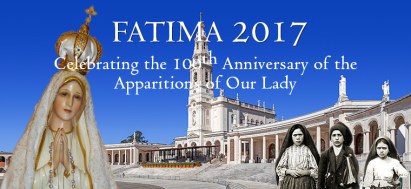
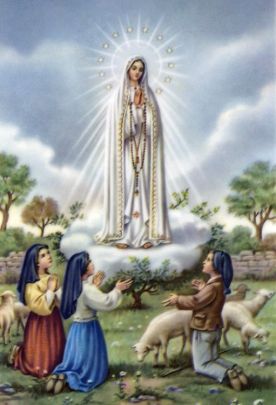 The Archdiocesan Marian Committee, in collaboration with the Worship Office and the Office of Multicultural Ministry, invite you to join Archbishop Kurtz and the priests and deacons of the Archdiocese of Louisville for a celebration of the 100th anniversary of the first appearance of Our Lady of Fatima in Portugal in 1917. Our Lady of Fatima brought us a message of peace, prayer, and penance from Heaven. The celebration will be held at the Cathedral of the Assumption on Saturday, May 13, 2017, the Feast of Our Lady of Fatima, beginning at 10:30 a.m. It will feature a multicultural Rosary and a Mass with the rarely-seen “Order for the Crowning of an Image of the Blessed Virgin Mary,” which makes available a special plenary indulgence. Please join our archdiocesan celebration!
Pray, fast, confess, receive the Eucharist, and be devoted to the Immaculate Heart
One hundred years ago, in 1917, three years into World War I, the world was in chaos. Christianity was being attacked from all sides by atheists and secular anti-church movements. The month was May, and Pope Benedict XV, moved by profound worry, sent out a petition to all Catholic bishops, asking for a litany of prayer to the Virgin Mary, whom he deemed “the Queen of Peace.” Only eight days later, on May 13, remarkable apparitions of Our Lady began in a remote area of Portugal. Mary, the mother of Christ, came to three shepherd children. Their lives were simple but filled with hope and unbreakable faith. They would be forever changed by Mary’s message.



 Formed In Faith